
I’ve worked with small businesses on SEO for over 15 years. And I know how it can feel: overwhelming, time-consuming, and expensive. It’s hard to know who to trust or where to start. Now, with the introduction of AI search and the pressure to build visibility on tools like ChatGPT and Google AI Overviews, it may feel even more daunting.
I get it. And I have good news.
The reason I love working with small businesses is that we are nimble. I say “we” because I, too, run a small business (our agency, webShine). Small business SEO and AI search are great because we can deploy a focused strategy and see results quickly, without a massive budget or a complete overhaul of everything you’ve built.
I’m also seeing real-world results for small and local business clients from simple changes right now. Adding reviews and testimonials, expanding website content, and clarifying who you are and what you offer are having an immediate impact on visibility in AI search.
So what are the most impactful things a small business owner can do to build visibility in AI tools alongside Google?
Four Ways to Build Visibility on ChatGPT, Claude & Google AI Overviews
1. Invest in the Written Word on Your Website
If there is one thing AI engines rely on to understand and recommend your business, it’s the written content on your website. Not your logo. Not your photos. Your words.
Two pages matter more than any others right now.
Your homepage is the anchor. It tells AI engines and your customers what you do, where you do it, and who you serve. Most small business homepages are thinner than they should be. A headline, a few short paragraphs, and a contact form aren’t enough context for an AI engine to recommend you with confidence. The more clearly and specifically your homepage answers the basics, the better your chances of showing up when someone asks ChatGPT or Google AI Overviews for a recommendation in your category.
Next is your about page. This is where trust is built. AI engines are looking for signals that real, credible people are behind a business. A thin “we founded this company in 2005” paragraph isn’t enough. Who are you? What’s your background? What do you care about? What makes your approach distinct? The businesses showing up in AI search tend to have about pages that read like a real introduction rather than a résumé.
This is also where your expertise lives. If you are a contractor who has spent 20 years specializing in historic home restoration, say that. If you are a therapist who works specifically with adolescents, say that. AI engines use that specificity to match your business to highly qualified searchers.
Beyond your core pages, blogging is one of the most effective ways to showcase expertise. Not every small business owner will have the time and budget for blogging, and that’s okay. But if you can publish even one thoughtful, well-written post a month, it’s worth it. A blog lets you go deep on specific topics in a way your homepage and about page can’t. It’s where your expertise shows up in action, not just in description.
Because blog posts can be so specific, they send a very clear signal to AI engines about who your audience is and what you specialize in. A contractor who blogs about historic home restoration isn’t just adding content. They’re telling AI engines exactly who their ideal client is and demonstrating the expertise to serve them. The more specific the topic, the more clearly AI engines can match you to the right searcher.
Of all the recommendations in this post, content deserves the most attention, roughly 60 to 70 percent of your effort. It’s the foundation on which everything else builds. The next recommendations matter, but they amplify content.
2. Claim and Optimize Your Google Business Profile
If your business serves a local area or has a physical location, a Google Business Profile is one of the most valuable things you can set up, and it’s free.
You’ve seen these listings before. When you search for a restaurant, a plumber, or a dentist on Google, the map with the pin and the business details on the right side of the screen is powered by Google Business Profile. It anchors your business to a specific location, which AI engines value when recommending small or local businesses.
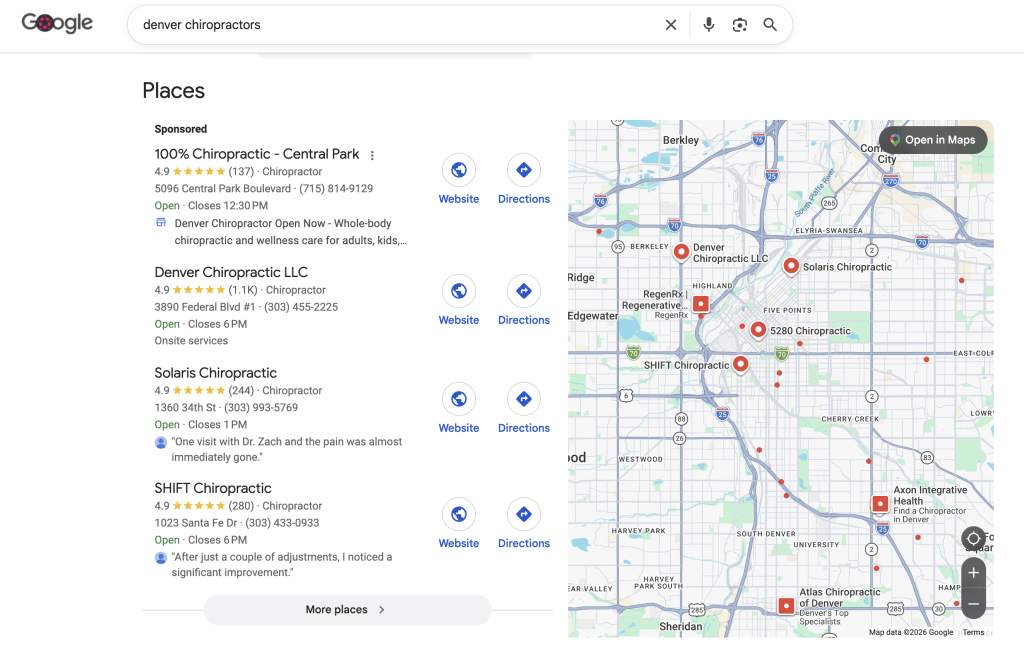
But its value goes beyond the map. Your Google Business Profile feeds structured, consistent information about your business directly to Google and AI tools, including your name, address, phone number, hours, category, and description. That consistency matters. Google and AI engines cross-reference information from multiple sources when deciding who to recommend. A well-maintained profile signals that your business is real, active, and trustworthy.
It also enables reviews, which we will cover in the next section.
You might be wondering whether a Google Business Profile applies to your business if you don’t have a physical storefront or serve clients in person. The answer is often yes. At webShine, we are a fully remote agency founded in Aspen, Colorado, serving clients across the US. We still maintain a Google Business Profile because it anchors our business to a place and adds a layer of credibility that supports our visibility across Google and AI search.
If you haven’t claimed your profile yet, start there. If you have one but haven’t updated it in a while, now is a good time to revisit it.
3. Earn Reviews That Tell a Story
Reviews are one of the most powerful real-world signals a small business can build. And they matter more in AI search than most people realize.
When someone asks ChatGPT or Google AI Overviews to recommend a business, these tools aren’t just looking at your website. They’re looking at what others say about you. Reviews are third-party validation: proof that real people have had real experiences with your business. That kind of credibility is hard to manufacture and easy for AI engines to recognize.
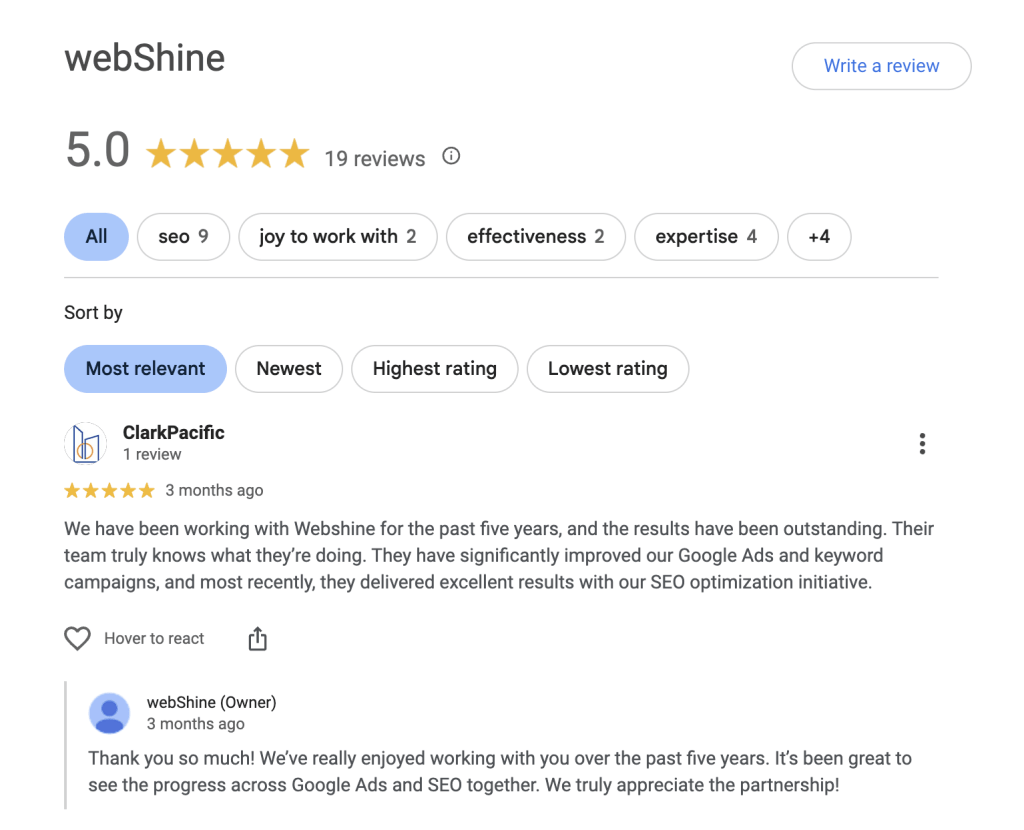
But not all reviews are created equal. A collection of five-star ratings with no text doesn’t tell AI engines much. What matters is the substance of the review. A customer who writes about their specific experience, names what they were looking for, and describes how your business delivered, gives AI engines exactly the kind of detailed, credible information they need to recommend you with confidence.
So, how do you get more and better reviews? Ask for them. Most happy customers are willing to leave a review when prompted, especially if you make it easy. When you follow up after a project or a purchase, include a direct link to your Google Business Profile. And when you ask, encourage them to be specific about what they valued most about working with you.
Where reviews live matters too. Google is the most important platform for most small businesses. But industry-specific directories, your own website, and other platforms where your customers are active all contribute to the broader picture AI engines build about your business.
4. Build Signals Beyond Your Website
Some of the most valuable things you can do for your visibility in AI search have nothing to do with your website directly. AI engines build a picture of your business from across the web, not just from what you publish yourself. Every time your business is mentioned, linked to, or described somewhere else online, it adds another data point to that picture. These are called off-site signals, and they are one of the most authentic forms of credibility a small business can build.
The good news is that many of the things you are already doing as a business owner naturally create these signals. Joining your local chamber of commerce gets your business listed on a credible, well-established website. Sponsoring a local event often earns a mention and a link from the event organizer. Being a guest on a podcast, contributing to a blog post, or being quoted in a local publication all do the same thing.
None of these feels like an SEO task. But they are.
The key is to apply an SEO and AI search lens to every off-site opportunity that comes your way. Ask yourself two questions: Is the information about my business consistent with what’s on my website? And is there an opportunity to get them to link back to my site?
Those two questions turn everyday business activities into visibility-building opportunities. Over time, a business with strong off-site signals tells AI engines something that a website alone never could: that real people, real organizations, and real communities recognize and trust this business.
We’re Here to Help
If this feels like a lot, we’re here to provide additional support.
At webShine, we work with small businesses in two ways. For those who want to accelerate through the fundamentals quickly, we offer one-time project-based work focused on the highest-impact tasks, from expanding your website content to cleaning up your Google Business Profile and building a strategy for AI search visibility.
For those who want ongoing support, we offer monthly engagements that keep the momentum going, including blogging, review strategy, and continued optimization as AI search evolves.
Either way, the first step is a conversation. Schedule a discovery call.